

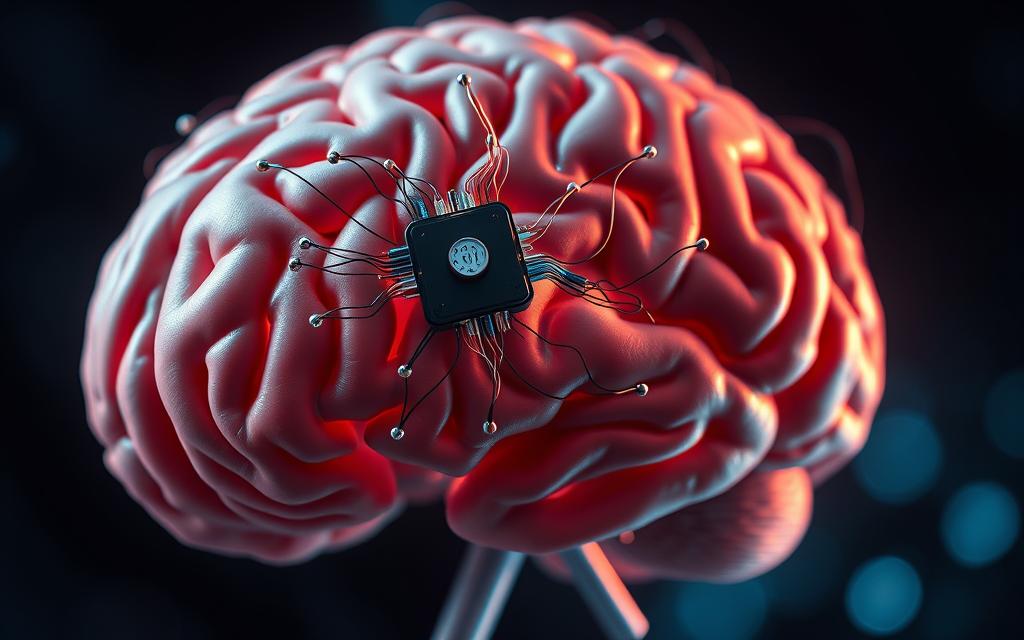
Imagine controlling computers or prosthetic limbs with your thoughts alone. This amazing possibility is becoming real thanks to advanced neural interfaces.
These devices create a direct link between our minds and external devices. They capture and understand electrical signals from our neurons.
Recent breakthroughs, like Neuralink’s human trials, show big steps forward. This tech has the power to bring back lost functions and boost our abilities.
This BCI technology overview looks into how these systems function. It also shows their groundbreaking uses in different fields.
Understanding Brain-Computer Interfaces: The Fundamentals
Brain-computer interface technology is a cutting-edge field that links our brain signals to digital systems. It’s a blend of science and technology. This section will dive into the basics of neural interface systems.
Defining Neural Interface Technology
A brain-computer interface (BCI) lets us talk directly to devices with our minds. It turns our brain signals into commands for computers, prosthetics, or other gadgets.
BCIs use both invasive and non-invasive methods. They’re special because they don’t rely on our muscles to communicate.
Neural interface tech has key features:
Related Posts:
- What Does Digital Mean in Technology The Foundation…
- How Technology Impacts the World Global Changes and…

- How Technology Changed the Entertainment Industry…

- How Technology Supports Student Learning Tools and…

- Can Trains Store Energy The Technology of…

- What Is Antisense Technology Gene Regulation and Medicine

- It captures brain signals in real-time
- Uses advanced algorithms to process these signals
- Allows communication in both directions
- Adapts to learn from us
Historical Development of Brain Chip Research
The journey of neural interfaces started in the 1920s with Hans Berger’s EEG discovery. He showed that we could record brain activity from the scalp.
Major milestones in brain chip research include:
- 1970s: Jacques Vidal introduces the term “brain-computer interface” and starts BCI experiments
- 1980s-1990s: Fetz et al. show that primates can control their brain activity
- 1990s-2000s: Miguel Nicolelis develops multi-electrode array technology
- 2000s-present: Advances in miniaturisation and wireless tech
These breakthroughs laid the groundwork for today’s neural interfaces. From simple EEG to advanced implants, it’s a story of teamwork and innovation.
Basic Principles of Neural Signal Processing
Grasping neural signal basics is key to understanding BCIs. It starts with detecting electrical signals from neurons firing in the brain.
Electrodes capture these signals by measuring voltage changes. The signals then go through several steps:
First, they’re amplified to make weak signals stronger. Then, filters remove unwanted noise. Next, patterns in the data are identified.
These patterns are then translated into commands for devices. This whole process happens fast, allowing us to interact with technology in real-time.
What Is Brain Chip Technology: Core Concepts Explained
To understand brain chip technology, we need to look at its basic parts and how it works. We’ll explore the main differences between interface types, the physical parts that make these systems work, and how neural activity is turned into commands.
Invasive vs Non-Invasive Neural Interfaces
Brain-computer interfaces are mainly divided into two types based on how close they are to brain tissue. Invasive BCI systems are implanted in the brain through surgery, using tiny electrode arrays. They get very detailed signals because they’re right next to the brain activity.
Non-invasive BCI systems, on the other hand, measure brain activity from outside the skull. They use technologies like EEG. These systems are safer but can get less clear signals because of the skull and scalp.
Choosing between invasive and non-invasive methods depends on how clear the signals are versus the risks. Invasive methods give very precise data but need surgery. Non-invasive methods are safer and easier to use but might not be as clear.
| Feature | Invasive BCI | Non-Invasive BCI | Practical Implications |
|---|---|---|---|
| Signal Resolution | High (single neuron level) | Low (regional brain activity) | Invasive enables precise control |
| Implantation Risk | Surgical procedure required | No implantation needed | Non-invasive has safety advantage |
| Signal Stability | Long-term consistency | Variable between sessions | Invasive offers reliability |
| Current Applications | Medical restoration | Research and basic control | Different development paths |
Key Components of Modern Brain Chips
Modern neural interfaces have many advanced parts working together. The electrode array is the main sensor, detecting electrical signals from neurons. These arrays differ a lot between invasive and non-invasive systems.
Signal processing units are another key part among brain chip components. These custom chips boost, filter, and digitise neural signals before sending them out. Companies like Neuralink make special processors to handle huge amounts of data from thousands of electrodes at once.
Wireless communication modules finish the system’s design. They use Bluetooth and other protocols to send data to devices without cables. This wireless feature is a big step up from older systems that needed cables.
How Neural Signals Are Captured and Interpreted
The journey of neural signal interpretation starts with detecting electrochemical signals. Electrodes pick up voltage changes from neurons firing. These tiny signals need a lot of amplification before they can be understood.
Then, advanced algorithms decode these signals into commands. Machine learning finds patterns in signals that match certain thoughts or actions. The system gets better at understanding these signals over time, thanks to feedback.
This process makes it possible for brain chips to control robots or computer interfaces. The complexity of neural signal interpretation algorithms determines how complex the interactions between brain and machine can be.
Major Types of Neural Interface Systems
Neural interface technologies have grown into different types. Each type has its own way of linking the brain to devices outside the body. They vary in how invasive they are, how precise they are, and what they’re used for in medicine and research.
Electroencephalography (EEG) Based Systems
EEG-based systems are the most basic type of brain-computer interface. They are non-invasive and use electrodes on the scalp to detect electrical signals. The EEG BCI method tracks voltage changes caused by neurons’ ionic currents.
These systems are great for medical use and research. They don’t need surgery, making them good for short-term checks. They can also spot different brain states fairly well.
They’re used in many ways, from medical tests to gaming. Scientists are working to make them better, even though they’re not perfect.
Intracortical Brain-Computer Interfaces
Intracortical interfaces are the most advanced neural implants today. They involve tiny electrodes put directly into the brain. The intracortical BCI method gives very detailed signals by catching neural activity right where it happens.
These implants use Utah arrays or similar tech with many tiny electrodes. They pick up signals from single neurons or small groups. This lets them control devices very accurately.
They’ve shown great results in helping people with spinal cord injuries. Patients can now control robotic arms and computer cursors just by thinking.
Emerging Technologies: Optogenetics and Ultrasonics
New methods are coming along, aiming for better results with less risk. Optogenetics is a new way to control neurons with light. It works by adding light-sensitive proteins to certain neurons.
Researchers can then turn these neurons on or off with light. It’s very precise for both recording and stimulating neurons.
Ultrasonic neural interfaces are another new area. They use sound waves to reach the brain without surgery. This method can stimulate the brain without needing to go inside.
Both are in the early stages but look very promising. They might offer the detail of invasive methods but with the safety of non-invasive ones.
| Interface Type | Invasiveness Level | Spatial Resolution | Primary Applications | Current Status |
|---|---|---|---|---|
| EEG-Based Systems | Non-invasive | Low (cm range) | Diagnostics, basic control | Clinically available |
| Intracortical BCIs | Fully invasive | High (μm range) | Prosthetic control, restoration | Clinical trials |
| Optogenetics | Minimally invasive | Single cell | Research, targeted therapy | Pre-clinical research |
| Ultrasonic Interfaces | Non-invasive | Medium (mm range) | Neuromodulation, research | Experimental stage |
Leading Research Initiatives and Key Players
The world of brain chip technology is led by many groups. They include private companies, top universities, and government projects. Each group uses its own way to push the field forward.

Neuralink: Elon Musk’s Ambitious Venture
Neuralink is a big name in brain-computer interfaces. It was started by Elon Musk. The goal is to make high-speed links between humans and computers.
Neuralink uses special robots for surgery. These robots put in tiny threads that can read and send signals. They hope to help people with paralysis and blindness first.
Now, Neuralink is testing these ideas on people. This is a big step for Neuralink Elon Musk. It shows how money from private investors can speed up research.
Academic Research Centres and Their Contributions
Universities have been key in brain-computer interface research for years. They focus on the science behind it, not just making products.
Some top places include:
- University of California teams pioneering motor cortex decoding
- Duke University’s research under Miguel Nicolelis on bidirectional interfaces
- University of Pittsburgh’s work on robotic limb control
This academic BCI research is the base for new technologies. Universities look at the science and ethics, too.
Government-Funded Neuroscience Programmes
Government agencies help a lot with brain chip tech. They fund big projects that private companies might not take on.
In the US, DARPA has started many projects. These include:
- BRAIN Initiative supporting basic neuroscience research
- Next-Generation Nonsurgical Neurotechnology development
- Neural Engineering System Design programmes
The National Institutes of Health (NIH) also gives a lot of money for brain-computer interfaces in medicine. This helps both military and civilian health.
These government efforts help set rules for safety and ethics. This guides how the field grows.
Medical Applications: Restoring Lost Functions
Brain chip technology is a big medical breakthrough. It offers real solutions for people with different neurological conditions. These devices help connect damaged brain paths to working parts, where old medicine can’t.
Paralysis Treatment and Motor Function Restoration
For those with spinal cord injuries or paralysis, BCI for paralysis brings new hope. The BrainGate trial shows great success. It lets tetraplegic people control robots and computers just by thinking.
These systems read brain signals to control devices, skipping damaged spinal areas. People can now drink from cups and type on keyboards. This tech is getting better, aiming for more natural control.
Treating Neurological Disorders and Brain Injuries
Neural interfaces also help with neurological disorder treatment. Deep brain stimulation helps Parkinson’s patients with tremors and movement. These devices send electrical pulses to the brain, fixing abnormal signals.
Studies are looking into using this tech for epilepsy, depression, and stroke recovery. A study in the National Library shows it can stop seizures before they start. For stroke victims, BCIs help rebuild brain connections through stimulation and feedback.
Sensory Restoration: Vision and Hearing Applications
Sensory restoration BCI tech has changed lives, like cochlear implants for hearing. These implants directly stimulate the auditory nerve, helping hundreds of thousands worldwide.
Visual prostheses aim to do the same for sight, but it’s harder. Early versions like Dobelle’s let the blind see light and shapes. Now, scientists are working on clearer vision.
Both hearing and sight devices turn outside signals into brain signals. As tech gets better, these devices will give users more natural experiences, even if they’ve lost these senses.
Augmentation and Enhancement Possibilities
The world of neural interfaces is pushing the limits of what we can do. It’s not just about fixing what’s broken. It’s about making us better than we are.
Cognitive Enhancement and Memory Augmentation
Brain-computer interfaces aim to make our minds stronger. Scientists dream of systems that speed up learning, improve memory, and sharpen decision-making.
Neuralink wants to link our brains with AI. This cognitive enhancement BCI could give us access to super-smart computers. It’s like getting a brain upgrade.
Studies show early success in boosting memory. Scientists have made it possible to encode and recall memories in the lab. This could change how we learn and work.
Direct Brain-to-Brain Communication Interfaces
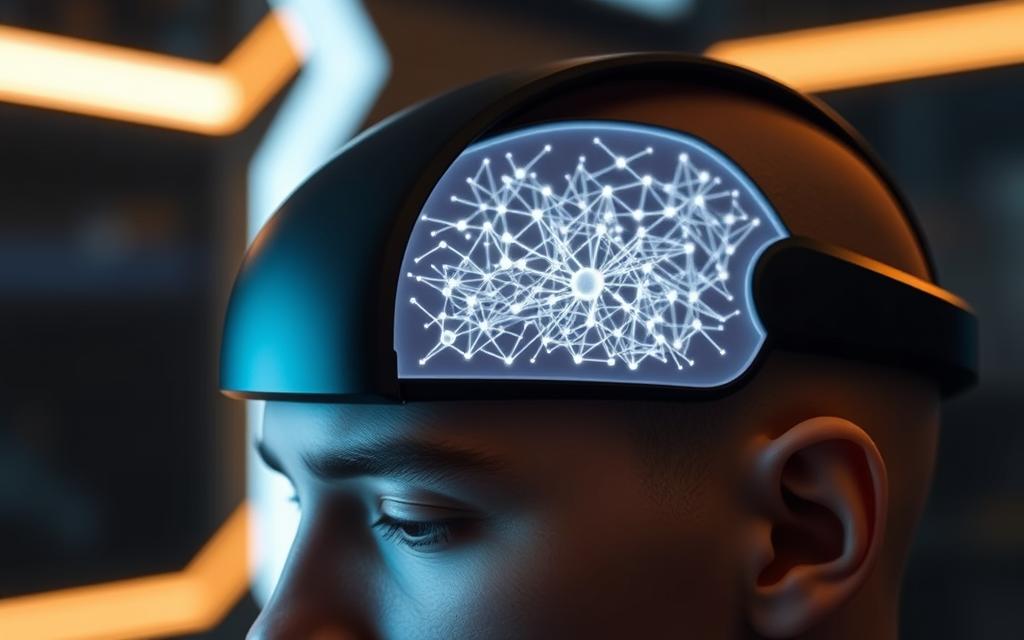
Brain-to-brain communication is a new way to talk. It lets people share thoughts without words.
Experiments have shown it’s possible to send simple ideas over long distances. This uses non-invasive tech to send messages.
This tech could change how we work together. It could also help in emergencies. Imagine sharing complex ideas instantly or communicating silently in critical situations.
Human-Machine Symbiosis Concepts
Human-machine symbiosis is about working together seamlessly. It’s about humans and computers as one team through neural interfaces.
With this tech, you can control devices with your mind. You could run complex machines, access information, or explore virtual worlds just by thinking.
Neuralink is exploring ways to merge humans with AI. This could make us better at solving problems and accessing knowledge.
Researchers are working on interfaces that can read and send signals back and forth. This creates a system where humans and machines work together, not apart.
Technical Challenges and Limitations
Brain chip technology is promising but faces many technical hurdles. These issues are in areas like signal processing, material science, and power management. Each area needs new engineering solutions.
Signal Resolution and Accuracy Issues
BCI signal accuracy is a big concern. The brain’s electrical patterns are complex and hard to decode. Environmental noise and other neural signals make it even harder.
Scar tissue around implants also affects signal quality. This means the signals get weaker over time. It’s a challenge for decoding algorithms to keep up.
The table below shows some key challenges and their effects:
| Challenge | Technical Impact | Potential Solutions |
|---|---|---|
| Signal-to-noise ratio | Reduced decoding accuracy | Advanced filtering algorithms |
| Cross-talk interference | Misinterpretation of commands | Multi-electrode arrays |
| Long-term signal stability | Progressive performance decline | Adaptive machine learning systems |
| Spatial resolution limits | Insufficient neural data capture | Higher density electrode designs |
Biocompatibility and Long-Term Implantation Concerns
Biocompatibility issues are a big challenge. The body sees implants as threats, leading to immune responses. This can harm both the device and the patient.
Material scientists are working on new coatings and materials. They aim to make implants blend in with the body. Research includes using hydrogel and materials that mimic the brain.
Long-term use of implants also poses problems. The brain’s movements and the body’s environment can damage implants. New materials and packaging are needed for long-term reliability.
Power Requirements and Data Transmission Challenges
The power needs for brain chips are a big problem. Devices need a steady power source without needing to be replaced often. Wireless charging and low-power chips are being explored, but more work is needed.
Transmitting data from implants is also a challenge. They produce a lot of information that needs to be processed quickly. Limited wireless bandwidth and security concerns make it hard to balance data quality and safety.
Researchers are looking into new solutions:
- Energy harvesting from body heat or movement
- Optical data transmission through skin
- Edge processing to reduce transmission requirements
- Advanced encryption for neural data security
These challenges are the main hurdles in brain-computer interface development. Progress is being made, but solving these problems will need teamwork from many fields.
Ethical Considerations and Social Implications
As brain chip technology moves from labs to real life, big ethical questions arise. These systems raise concerns about privacy, fairness, and who we are. Society must think deeply about these issues before they become common.
Privacy Concerns and Neural Data Protection
Neural data is very private. Brain-computer interfaces can read our thoughts, feelings, and thoughts. This sensitive info needs strong protection.
Key privacy risks include:
- Unauthorised access to neural patterns and mental states
- Commercial exploitation of cognitive and emotional data
- Government surveillance through neural monitoring
- Psychological manipulation based on neural vulnerabilities
Current data protection laws might not be enough for neural info. New rules are needed to keep this personal data safe.
Equity and Access: The Risk of Neuro-inequality
The cost of advanced neural interfaces worries about fairness. If only the rich can get these upgrades, a new inequality could start.
This neuro-inequality could lead to:
- People with upgrades getting ahead in school and work
- Healthcare with special neural treatments for the rich
- Society divided by who has upgrades
- Generations left behind without access to these technologies
Without careful planning, brain chips could make social gaps worse, not better.
Identity and Agency: Philosophical Questions
Neural interfaces make us question who we are and our free will. When tech changes our thoughts and choices, we need to rethink identity and control.
Questions arise about whether enhanced people are truly themselves or something new. The BCI ethics identity debate asks how these technologies change:
- Our ability to make choices
- Our consciousness and feelings
- Our moral responsibility for actions influenced by tech
- What it means to be human
These questions are complex but important for ongoing ethical talks as tech advances.
We need everyone involved to tackle these big issues. By working together, we can make sure brain chip tech is used for the good of all.
Regulatory Landscape and Safety Standards
Brain chip technology is advancing fast. This means we need strong rules to keep patients safe and devices working well. Governments around the world are creating special rules for neural interfaces.
Current Regulatory Frameworks for Medical Devices
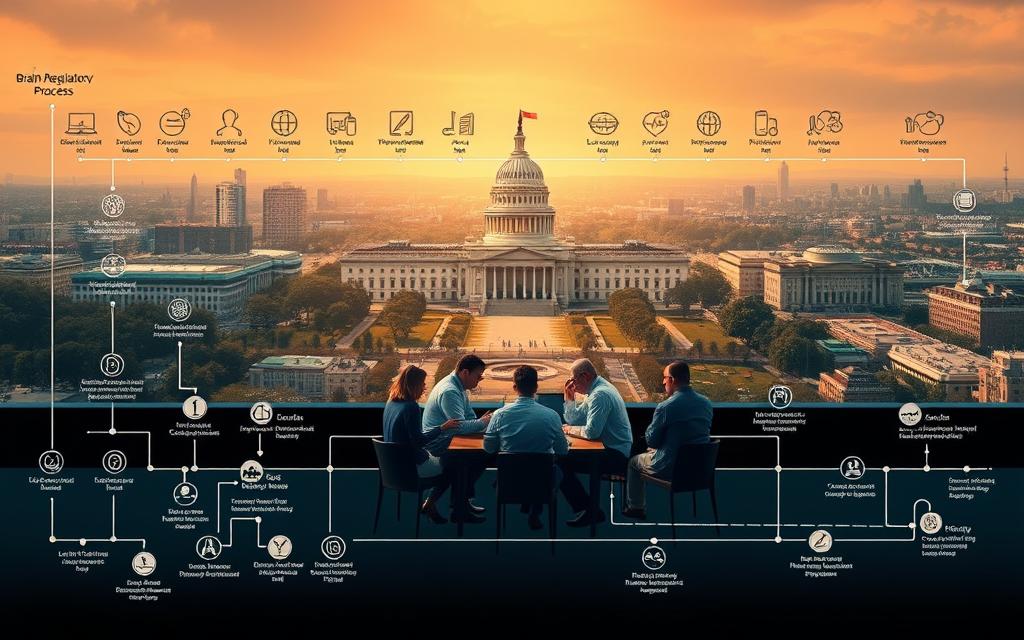
In the United States, the FDA sorts neural interfaces by risk and use. Most brain-computer interfaces are Class III, needing approval. They must show they are safe and work well before being used.
Europe uses the CE marking system under Medical Device Regulation (MDR). Bodies check if devices meet the rules. Both systems need detailed plans and quality control from start to end.
International Standards and Compliance Requirements
Groups like the International Organisation for Standardisation (ISO) help make rules for neural interfaces. ISO 13485 and IEC 60601 are key for following rules.
Companies face big challenges like making devices work with other tech, testing software, and keeping data safe. These global standards help ensure safety everywhere.
Clinical Trial Protocols and Safety Assessments
Clinical trials for neural interfaces have different steps. Phase I checks safety in a few patients. Phase II looks at how well the device works and the right amount to use.
Tests include checking if the device is safe to use for a long time and what might go wrong. Committees watch over patients to make sure they are okay and know what they are getting into.
Regulators are changing old rules to fit new brain chip tech. The FDA’s Breakthrough Device Designation programme speeds up reviews for new BCI tech while keeping safety in mind.
Commercial Applications and Market Trends
Brain chip technology is growing fast in many areas, not just medicine. It’s moving into healthcare, consumer electronics, and special industrial uses. This growth shows how far technology has come and how people are starting to accept these systems.
Healthcare and Medical Device Market Analysis
The healthcare sector is where brain-computer interfaces are most established. Neuroprosthetics and diagnostic tools are leading the way, with lots of investment in new ideas. The market is expected to keep growing in several key areas:
- Neurological disorder treatment devices
- Rehabilitation and physical therapy systems
- Advanced diagnostic monitoring equipment
- Chronic pain management solutions
Experts predict the medical BCI sector will grow at a rate of compound annual growth exceeding 15% over the next decade. This is due to better technology and more approvals for use in clinics.
Consumer Electronics and Gaming Applications
Consumer applications are another exciting area for brain chip technology. Companies are making non-invasive systems for new ways to interact and enjoy things. These systems are mainly for:
- Immersive gaming experiences
- Focus and meditation enhancement tools
- Educational and learning acceleration devices
- Basic communication aids for general consumers
The entertainment industry is really interested in EEG-based headsets. These measure how engaged and emotional people are. Big tech companies are working on these, showing they believe in their future.
Industrial and Defence Sector Utilisation
Neural interfaces are also being used in industrial and defence areas. These sectors see BCIs as a way to improve human performance in tough situations. Current uses include:
- Hands-free equipment control in hazardous settings
- Enhanced communication systems for tactical operations
- Monitoring and optimising operator attention and fatigue
- Advanced training and simulation systems
In defence, BCIs are being explored to improve awareness and reaction times. Governments are looking into how these systems can help soldiers.
| Sector | Current Market Value | Projected Growth | Key Applications |
|---|---|---|---|
| Healthcare | $1.2 billion | 15.7% CAGR | Neuroprosthetics, diagnostics |
| Consumer Electronics | $480 million | 22.3% CAGR | Gaming, wellness devices |
| Industrial/Defence | $310 million | 18.9% CAGR | Control systems, monitoring |
Brain chip technology is moving from research to real-world uses. The different growth rates show the technology’s current state and its future possibilities.
Future Developments and Research Directions
Neural interface technology is growing fast, with new ways to improve performance and user experience. Researchers are looking into material science, artificial intelligence, and system design. These areas are key to the next big steps in brain-computer interfaces.
Next-Generation Materials and Miniaturisation
Material science is a big area of focus for neural interfaces. Scientists are working on new materials that reduce scarring and improve long-term use. These include flexible polymers and conductive hydrogels that feel more like brain tissue.
There’s also a push to make devices smaller and less invasive. The goal is to create tiny electrodes and ultra-thin implants. This could change how we interact with our brains.
Artificial Intelligence Integration in Neural Interfaces
AI is changing how we understand brain signals. Machine learning can spot patterns in brain activity that were hard to see before. This AI in neural interfaces is a big step forward.
These systems can learn and get better over time. They adapt to user feedback and changing brain patterns. AI helps them understand signals better and even predict what we might do next.
Wireless and Fully Implantable System Development
There’s a big push to make neural interfaces wireless. This would get rid of the need for external wires and visible devices. The goal is to create wireless brain implants that work on their own.
Future systems might use biofuel cells or inductive charging. The dream is to have implants that are invisible and work all the time. This would make brain-computer interfaces more common in everyday life.
Conclusion
Brain chip technology is a big leap in neuroscience and biomedical engineering. It aims to bring back lost functions and boost human abilities. It also aims to connect humans and machines more closely.
It has many uses, like helping people with paralysis. It also looks into making our minds work better with technology. The possibilities are endless.
But, there are hurdles like making sure signals are clear and safe. We also need to think about privacy and fairness. Laws need to change to keep everyone safe and trust the technology.
This summary shows we need to move forward carefully. We must balance new discoveries with careful thinking and fairness. The goal is to use this technology wisely for everyone’s benefit.
It’s important to keep studying and talking about this. As we learn more, brain-computer interfaces could change lives. They might make things we thought were dreams come true a reality.
FAQ
What is brain chip technology and how does it work?
Brain chip technology lets us talk to devices with our minds. It uses sensors to catch electrical signals from our brain. These signals help us control gadgets or even regain lost abilities.
What are the differences between invasive and non-invasive neural interfaces?
Invasive tech, like Neuralink, goes inside the brain for better signals but is risky. Non-invasive tech, like EEG headsets, is safer but less precise. It’s all about finding the right balance between safety and performance.
Who are the key players in brain chip technology research and development?
Neuralink, led by Elon Musk, is working on brain implants for big changes. Universities like UC and Duke are also key, thanks to researchers like Miguel Nicolelis. Government projects, like DARPA’s BRAIN initiative, help push the field forward.
What medical applications do brain chips currently support?
They help people with paralysis control devices and treat Parkinson’s disease. They also help the blind see by creating light in their mind. These are just a few examples of how brain chips are changing lives.
Can neural interfaces be used for enhancement beyond medical purposes?
Yes, they can. We’re talking about making our brains better at learning and memory. They could even let us share thoughts directly or merge with AI. But these ideas are just starting to be explored and raise big questions.
What are the main technical challenges facing brain chip technology?
The big hurdles are getting clear signals without noise and making sure they’re safe for our bodies. We also need to figure out how to power them without batteries. And we need fast, secure ways to send data.
What ethical issues are associated with neural interfaces?
There are many concerns. Privacy is a big one, as our brain data could be stolen. There’s also the issue of who gets to use these technologies, leading to unfair advantages. And then there’s the question of how they might change who we are.
How are brain chip technologies regulated for safety and efficacy?
Rules come from places like the FDA in the US and CE marking in Europe. There are also international standards and strict trials to follow. This ensures they’re safe and work as promised.
What commercial markets are adopting neural interface technology?
It’s being used in healthcare, gaming, and even defence. The growth is driven by new uses and improvements. It’s a rapidly expanding field with lots of possibilities.
What future developments are expected in brain chip technology?
We’re looking at better materials and smaller sizes. Artificial intelligence will help make sense of brain signals. And we’re working on wireless systems for easier use. These changes aim to make brain chips more effective and accessible.
