

In today’s world, digital technology is key to our daily lives. It shapes how we learn, talk to each other, and have fun.
The digital technology definition talks about tools, systems, and devices that handle data. This is what makes modern computing work smoothly.
Things like smartphones and cloud services are more than just gadgets. They’re part of a big system that brings new ideas and connects us all.
Getting to know this idea helps us understand our tech world better. It shows us how our digital lives are built and grow.
Defining Digital: Beyond the Buzzword
The term ‘digital’ has become very common in today’s tech world. But, its roots are surprisingly connected to our bodies. This part looks into what ‘digital’ really means, beyond just being a buzzword. We’ll explore its history and how it works technically.
The Etymology and Basic Meaning
The word ‘digital’ comes from the Latin ‘digitus’, meaning finger or toe. This is because ancient people counted using their fingers. So, the idea of digital started with counting with our fingers.
In tech, ‘digital’ means systems that use clear, separate values. As one source explains,
“Digital computer… operates on data… expressed in binary code—i.e., using only the two digits 0 and 1.”
This binary system is at the heart of all digital tech.
Related Posts:
- How Technology Impacts the World Global Changes and…

- How Technology Supports Student Learning Tools and…
- What Is Brain Chip Technology Neural Interfaces Explained
- How Technology Changed the Entertainment Industry…

- What Is DuraShock Technology Rugged Footwear Construction

- Can Trains Store Energy The Technology of…

Digital vs Analog: The Fundamental Distinction
Digital and analog systems differ in how they handle information. Digital systems use clear, separate values. Analog systems use continuous signals that change smoothly over time.
This difference affects how information is processed. The debate is about which method is better for different tech uses in various fields.
Characteristics of Digital Systems
Digital systems have key features that make them great for today’s computers:
- Discrete values: They use clear, separate states (usually 0 and 1)
- Noise immunity: Digital signals stay strong over distance and through interference
- Precision and accuracy: Clear values mean exact information
- Error detection and correction: They can spot and fix errors
- Storage efficiency: Digital data can be stored more tightly
Characteristics of Analog Systems
Analog systems are less common today but are important in some areas:
- Continuous signals: They use smoothly changing values that reflect real-world things
- Infinite resolution: Analog systems can show values with perfect detail
- In direct representation: They often show physical quantities directly
- Real-time processing: Analog systems can handle information quickly without delay
- Natural interface: Many natural phenomena are analog
The shift from analog to digital has changed how we handle information in tech. Knowing the difference helps us see why digital tech is so dominant today.
The Historical Evolution of Digital Technology
The journey of digital technology is one of humanity’s most remarkable transformations. It moved from mechanical calculators to electronic systems. This change is key to understanding how digital technology has changed our world.
Early Digital Systems and Their Limitations
Long before electronics were common, early digital devices started to appear. In the 17th century, Blaise Pascal created mechanical calculating machines. These machines used gears and wheels to do basic math.
Charles Babbage thought of the Analytical Engine in the 1830s. It had parts like modern computers, like memory and processing units. Babbage’s ideas, though not built in his time, laid the groundwork for digital computing.
But early systems had big problems:
- They were huge and needed a lot of space
- They were slow because of their mechanical parts
- They often broke down and needed a lot of upkeep
- They could only do simple math
These issues lasted until electronics took over, marking a big change in computing history.
The Digital Revolution: Key Milestones
The shift to electronic systems started the digital revolution. This period saw huge leaps in computing power, reliability, and how easy it was to use. Many breakthroughs made this era transformative.
The Transistor’s Impact
Transistors came out in the 1950s, replacing big vacuum tubes. These small devices brought many benefits that sped up the digital revolution:
| Characteristic | Vacuum Tubes | Transistors |
|---|---|---|
| Size | Bulky and large | Compact and small |
| Power Consumption | High energy usage | Low power requirements |
| Reliability | Frequent failures | Long-lasting operation |
| Heat Production | Significant heat output | Minimal heat generation |
John Bardeen, Walter Brattain, and William Shockley’s invention made computers smaller and more efficient. This helped John V. Atanasoff’s work on electronic digital computers.
The Integrated Circuit Breakthrough
Integrated circuits came out in the late 1950s, changing digital technology even more. Jack Kilby and Robert Noyce each found ways to put many transistors on one chip.
This breakthrough opened up new possibilities:
- Computers became much smaller and cheaper
- They got faster and more reliable
- It led to the development of microprocessors
- It made it easier to make electronic parts in large numbers
The integrated circuit was key to making modern microprocessors and personal computers. It helped move from big machines to small devices, defining the digital revolution.
These milestones changed digital technology from ideas to tools that change our lives every day. The computing history that followed built on these key breakthroughs.
Binary Systems: The Language of Digital Technology
At the heart of every digital device is a simple yet powerful language. It uses only two symbols to represent all information. This binary system is the foundation of modern computing. It enables everything from simple calculations to complex artificial intelligence.
Understanding Binary Code
Digital technology runs on binary code—using only 0 and 1. This limited system is incredibly flexible. Each digit represents a simple on/off state that computers can process with perfect accuracy.
Bits and Bytes: The Building Blocks
A single binary digit is called a bit. It’s the most basic unit of digital information. When eight bits are grouped together, we get a byte. This is the fundamental building block that computers use to represent characters, numbers, and instructions.
This organisation allows for complex information representation. For example, a single byte can represent 256 different values (2^8). This enables the encoding of letters, symbols, and numerical values that form all digital content.
How Computers Process Binary Information
Computers process binary information through electrical circuits. These circuits recognise two voltage levels—high and low—corresponding to 1s and 0s. This physical representation of binary states enables incredibly fast processing speeds that analog systems cannot match.
Logic Gates and Their Functions
The processing of binary information occurs through logic gates. These gates are fundamental components that perform basic logical operations. They take binary inputs and produce specific outputs based on their designed function.
There are several primary types of logic gates. Each has distinct operational characteristics:
| Gate Type | Function | Input Pattern | Output |
|---|---|---|---|
| AND | Produces 1 only if all inputs are 1 | 1, 1 | 1 |
| OR | Produces 1 if any input is 1 | 0, 1 | 1 |
| NOT | Reverses the input value | 1 | 0 |
| XOR | Produces 1 if inputs differ | 1, 0 | 1 |
These basic logic gates combine to form complex circuits. These circuits perform arithmetic operations, make decisions, and create sophisticated computing systems. The elegant simplicity of binary code and logic gates shows how powerful digital technology emerges from simple principles.
Digital Representation of Information
Digital technology changes how we handle information. It turns real-world signals into digital formats computers can use. Learning about digital representation shows how modern computers work.
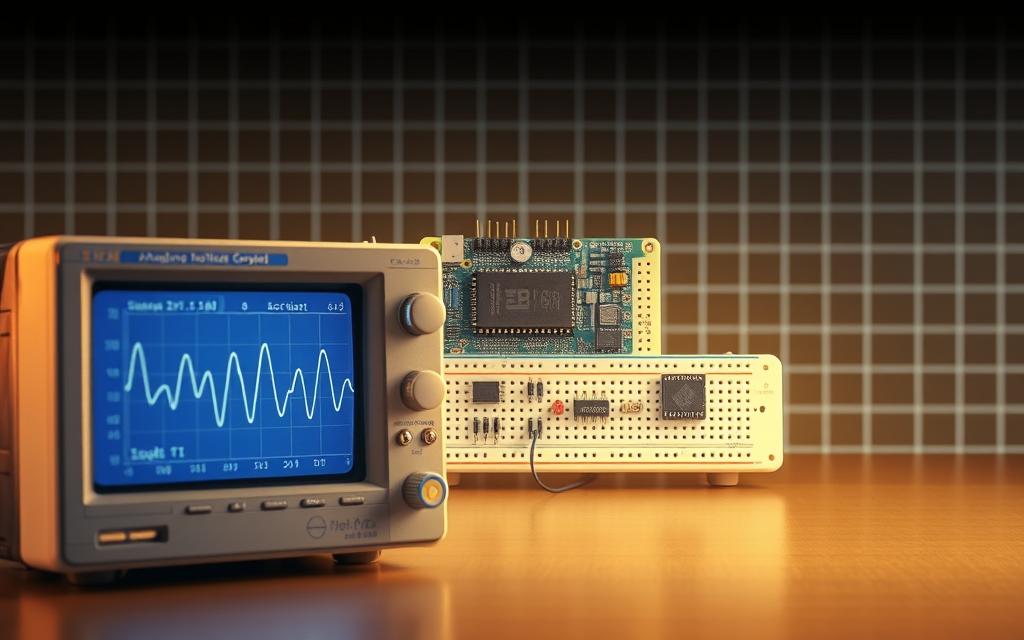
Converting Analog to Digital: The Sampling Process
The first step to digital is sampling. Analog signals, like sound or images, are continuous. Digital systems capture these signals at set times through three steps:
- Sampling: Measuring the signal’s amplitude at certain times
- Quantisation: Giving each sample a specific number
- Encoding: Turning these numbers into binary code
This process lets computers handle real-world info with great accuracy. The sampling rate shows how well the digital version matches the original.
Digital Storage Principles
After conversion, digital info needs reliable storage. Storage devices use key principles for easy access and safety. Common types include:
- Hard disk drives (HDDs)
- Solid-state drives (SSDs)
- Optical media (CDs, DVDs)
- Flash memory devices
These systems keep data safe using magnetic, optical, or electronic methods. Data is organised for easy retrieval. Modern storage keeps getting better, with more space and faster access.
Data Compression Techniques
Compression makes files smaller without losing important info. There are two main types:
| Compression Type | Methodology | Common Applications | Data Recovery |
|---|---|---|---|
| Lossless | Reduces statistical redundancy | Text files, databases | Perfect reconstruction |
| Lossy | Removes less important info | Images, audio, video | Approximate reconstruction |
| Hybrid | Uses both methods | Modern multimedia formats | Variable quality recovery |
Lossless compression keeps all data, like ZIP or PNG. Lossy methods, like JPEG or MP3, trade some quality for size. The choice depends on how much quality you need versus size.
These methods help send and store digital info efficiently. They’re key to managing the growing amount of digital data.
What Does Digital Mean in Technology Today
Today, digital technology has changed from just computers to systems that change whole industries. It’s not just about code and processors anymore. It’s about whole digital worlds that change how we live and work.
Contemporary Applications Across Industries
Digital tech is in every field, bringing new solutions and changing old ways. From health checks to city planning, these digital applications show how tech has grown from tools to key parts of our lives.
Digital Communication Systems
Digital systems have changed how we talk to each other. Email, messages, and VoIP have made old ways seem old-fashioned.
These systems use internet technology for fast, clear talks. Companies use them to make talking easier across different digital channels.
Even cities use digital tech for better traffic and safety. Smart lights and crossings use sensors for better traffic flow.
The entertainment world has gone fully digital. Streaming and online games connect people everywhere.
Smart TVs and players have changed how we watch and play. We want shows and games that fit our tastes and work on all devices.
Digital media uses smart tech to guess what we like. This helps make shows and games that really grab our attention.
The Internet as a Digital Ecosystem
The internet is the biggest example of digital technology today. It’s a huge network that supports lots of services and apps.
This network lets us share info instantly, use cloud services, and shop online. The World Wide Web, started in the 1990s, keeps getting better with new internet technology.
The internet is the base for digital changes in many areas. It supports online shopping, social media, and learning. It’s key for making our world more connected and efficient.
The internet’s design lets different digital applications work together. This makes our online experiences better and opens up new ways to communicate, have fun, and get things done.
Digital Hardware Components
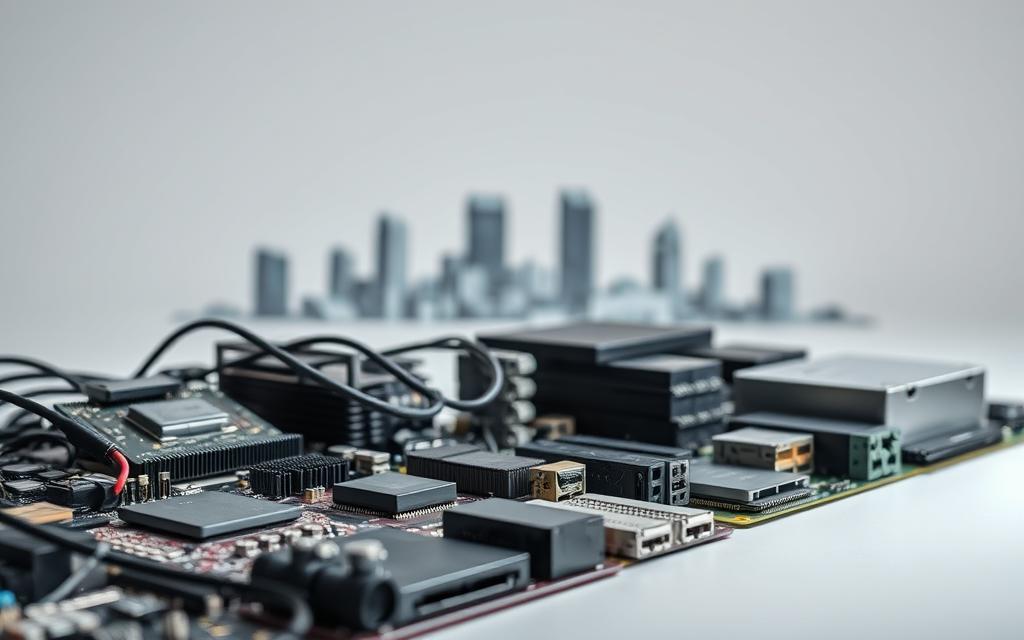
Every digital device has a set of physical parts that work together. These parts are key to modern computing. They help with simple tasks and complex artificial intelligence.
Processors and Their Architecture
The central processing unit is the brain of digital systems. Modern processors have complex designs for better performance. The control unit manages instructions, and the arithmetic-logic unit does math.
Today’s processors are built for parallel processing. They have multiple cores that work on different tasks at once. This makes them fast for tough tasks.
Memory Systems in Digital Devices
Digital devices use different types of memory. Main memory holds data and programs temporarily. Peripheral equipment adds more storage space.
Memory and processors work together for smooth operation. Fast memory access is key to avoiding delays. Good memory management is essential for device performance.
RAM vs ROM: Digital Memory Types
Random Access Memory is for active applications. It loses data when power goes off. Computers use RAM for quick data access.
Read-Only Memory holds permanent instructions. It keeps data without power. Devices use ROM for basic system instructions.
RAM and ROM are both important. RAM helps with multitasking and fast data access. ROM keeps essential system instructions the same.
Software: The Digital Intelligence
Hardware is the physical base of digital tech, but software gives it life. This digital software includes programmes and instructions. It turns hardware into powerful tools.
Operating Systems as Digital Platforms
Operating systems are the core software. They manage hardware and provide services for apps. They handle tasks like memory and file organisation.
Today’s operating systems let many apps run at once. They make it easy for developers to create without worrying about hardware details.
The growth of operating systems has kept pace with hardware. We have Windows, macOS, Linux, Android, and iOS now. Each offers unique features and ways to use digital resources.
Programming Languages and Digital Logic
Programming languages connect human ideas to machine actions. They use digital logic that computers can understand. This makes software development easier and more efficient.
Programming languages range from simple to complex. From assembly languages to Python and Java, each has its strengths. They help solve different problems in digital tech.
The bond between programming languages and hardware is key. As one expert says:
“Programming languages translate human intent into binary instructions that hardware can process, creating the intelligent behaviours we expect from modern computing systems.”
This shows how complex and important software development is. It requires efficiency, reliability, and top performance.
The Future of Digital Technology
Digital innovation is speeding up fast. New technologies are changing how we work and live. They promise big changes in many areas.

Emerging Digital Technologies
New technologies are set to change our digital world. They are the next big steps in how we process information.
Quantum Computing’s Promise
Quantum computing is a big deal. It uses special computers that can do things regular computers can’t.
These computers can solve problems that would take years. They could help find new medicines and understand the weather better.
“Quantum computing represents not just an improvement, but a fundamental shift in how we approach computational problems.”
Big companies and scientists are working hard on quantum computing. But, we’re just starting to see what it can do.
Digital Transformation Trends
Digital changes are happening fast in many areas. Key trends include:
- Artificial intelligence getting smarter
- The Internet of Things connecting more devices
- Edge computing making things happen faster
- Advanced chips making computers better
These changes are taking us to new places. Computers are getting smaller but doing more. This shows how far we’ve come in making chips.
| Technology Trend | Current Impact | Future Promise | Key Challenges |
|---|---|---|---|
| AI Integration | Automating simple tasks | Big data analysis | Dealing with ethics |
| IoT Expansion | Smart home gadgets | Smart cities | Keeping things safe |
| Edge Computing | Quick responses | Self-driving cars | Setting up the right systems |
| Quantum Computing | Special calculations | Big challenges solved | Keeping it stable |
Digital changes are affecting all areas, from health to making things. Companies that adapt will do well in the future.
The future of digital tech is exciting but also brings big challenges. As these technologies grow, they will change our lives and work in big ways.
Conclusion
This look at digital technology shows how far it has come. From simple binary systems to the complex systems we use today. It has changed how we process, store, and share information in all areas of life.
Computing has grown a lot, but the basics of digital technology stay the same. This shows that even as technology gets better, the core ideas of binary and digital logic keep us moving forward.
The future looks bright for digital technology. It will keep changing how we live, with more artificial intelligence, quantum computing, and connected systems. This summary highlights the big changes and the lasting ideas of our digital world.
FAQ
What is the basic meaning of digital in technology?
In tech, “digital” means systems that use 0s and 1s to handle data. This comes from the Latin “digitus”, meaning finger. It’s linked to counting on fingers, leading to our digital systems today.
How do digital systems differ from analog systems?
Digital systems use 0s and 1s for clear data handling. They’re good at avoiding noise and being precise. Analog systems, on the other hand, use continuous signals. They can get affected by interference and are less accurate.
What were some early digital systems and their limitations?
Early systems included mechanical calculators like Pascaline and Babbage’s Analytical Engine. They were big, slow, and often broke easily.
What key milestones marked the digital revolution?
The digital revolution was marked by the invention of the transistor and integrated circuits. These made computers smaller and more reliable. People like John Atanasoff and Konrad Zuse also played big roles.
What is binary code and how is it used in digital technology?
Binary code is the language of digital tech, using only 0s and 1s. A bit is a single binary digit. Eight bits make a byte, the basic unit for storing and processing digital info.
How do computers process binary information?
Computers use logic gates to process binary info. Gates like AND, OR, and NOT perform basic operations. They help computers do complex tasks by making simple decisions.
How is analog information converted into digital format?
Converting analog to digital involves three steps: sampling, quantisation, and encoding. Sampling measures the signal, quantisation assigns values, and encoding turns these into binary code.
What are the principles behind digital storage?
Digital storage organises data using binary code. It’s structured into bits and bytes. Data compression, both lossless and lossy, is used to make files smaller while keeping info intact.
What are some contemporary applications of digital technology?
Digital tech is used in many areas, like communication, media, healthcare, and smart homes. The internet connects these applications, making them work together.
What hardware components are essential in digital systems?
Key components include processors and memory systems. Processors, like the CPU, handle tasks. Memory, like RAM and ROM, stores data temporarily and permanently.
How does software function as the intelligence behind digital hardware?
Software, like operating systems and programming languages, tells hardware what to do. Operating systems manage resources and support apps. Programming languages create instructions for software.
What emerging technologies are shaping the future of digital technology?
New tech includes quantum computing and AI. Quantum computing uses qubits for complex problem-solving. AI, IoT, edge computing, and miniaturisation are also changing the game.
What is digital transformation and how is it evolving?
Digital transformation means using digital tech in all parts of business and society. It’s changing how we operate and deliver value. Advances in AI, IoT, cloud computing, and data analytics are driving these changes.
